
In 2026, the traditional security perimeter is entirely obsolete. To survive an era dominated by autonomous exploits, organizations are shifting their strategy from absolute prevention to continuous operational resilience. This deep dive explores how modern enterprises are rebuilding their security posture using a mature Zero Trust Architecture to withstand, adapt to, and rapidly recover from sophisticated cyber incidents. You will learn how to integrate agentic AI security, deploy quantum-resistant cryptography, and leverage unified SASE frameworks to maintain business continuity even during an active compromise.
- Resilience Over Prevention: Modern security assumes breach and focuses on minimizing blast radiuses through microsegmentation.
- Agentic AI Defenses: Autonomous AI agents are required to counter AI-driven threat actors in real-time.
- Future-Proofing Cryptography: Transitioning to NIST-approved post-quantum algorithms is no longer optional.
How Does Zero Trust Architecture Enable Continuous Resilience?
Zero Trust Architecture is no longer a conceptual framework; it is the operational baseline for the modern enterprise. By enforcing the principle of least privilege and continuous verification, organizations ensure that a compromise in one branch does not lead to systemic failure. In 2026, this is achieved through identity-first security pipelines that verify every user, device, and workload session dynamically.
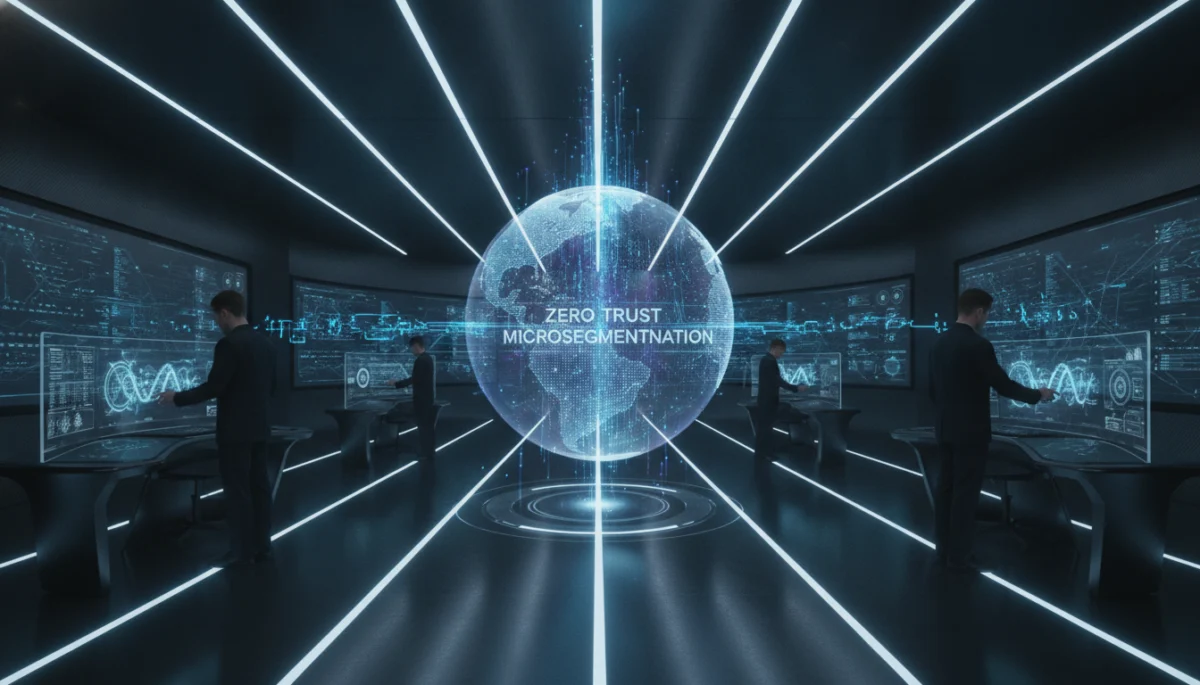
Microsegmentation has evolved from static network zoning to dynamic, software-defined boundaries. These boundaries adapt in real-time based on contextual risk scores, user behavior analytics, and device health. When an anomaly is detected, the affected segment is isolated instantly, preventing lateral movement without disrupting the broader corporate ecosystem.
How Do We Secure the Rise of Agentic AI in the Enterprise?
As organizations deploy autonomous AI agents to automate decision-making, securing these systems has become a primary directive. Agentic AI security focuses on protecting the integrity of LLM-based agents that possess the agency to execute API calls, access databases, and alter system configurations. Without robust guardrails, these agents can be manipulated via prompt injection or data poisoning.
Securing agentic workflows requires continuous runtime monitoring and strict privilege boundaries for AI identities. Security teams must treat AI agents as non-human identities (NHIs), applying the same Zero Trust validation principles used for human users. This includes rate-limiting agent actions, logging all decisions, and requiring human-in-the-loop validation for high-risk operations.
Why Must Organizations Adopt NIST Quantum-Resistant Algorithms Now?
The threat of “Harvest Now, Decrypt Later” has made immediate cryptographic migration a necessity. Adversaries are actively intercepting and storing encrypted enterprise data with the intent of decrypting it once cryptanalytically relevant quantum computers (CRQCs) become available. Waiting for quantum hardware to mature before updating encryption standards guarantees future exposure.
To mitigate this risk, organizations must integrate the NIST Quantum-Resistant Algorithms into their active data protection strategies. Transitioning to algorithms like ML-KEM and ML-DSA requires a comprehensive discovery phase to map all cryptographic assets. Achieving cryptographic agility—the ability to swiftly update algorithms without disrupting underlying infrastructure—is now a core metric of enterprise resilience.
What Is the Role of SASE in a Distributed Ecosystem?
The convergence of networking and security via Secure Access Service Edge (SASE) is critical for protecting a highly distributed workforce. In 2026, SASE platforms seamlessly unify Security Service Edge (SSE) components—such as Cloud Access Security Brokers (CASB) and Zero Trust Network Access (ZTNA)—with software-defined wide area networking (SD-WAN). This consolidation eliminates security silos and reduces latency.
A resilient SASE framework ensures that security policies follow the user and the workload, regardless of location. Real-time posture assessment continuously monitors connecting devices for vulnerabilities or active compromises. By processing security policies at the edge, organizations can detect and mitigate threats closer to the source, preventing malicious traffic from ever reaching core cloud resources.
How Does AI-Driven Threat Hunting Accelerate Incident Recovery?
Defenders can no longer rely on manual triage to counter automated exploits. AI-driven threat hunting platforms leverage machine learning models to analyze petabytes of telemetry data across endpoints, networks, and cloud environments in real-time. These systems identify subtle indicators of compromise (IoCs) that traditional signature-based tools overlook.
According to recent industry benchmarks, organizations employing autonomous threat hunting have reduced their mean time to detect (MTTD) from days to seconds. This rapid identification is coupled with automated containment protocols, allowing defensive systems to neutralize threats before they escalate into full-scale breaches. By automating the discovery and containment phases, human analysts can focus their efforts on root-cause analysis and long-term system hardening.
To begin transitioning your organization from a posture of simple prevention to true operational resilience, start by conducting a comprehensive inventory of your non-human identities and cryptographic assets. Prioritize the integration of quantum-resistant standards within your external-facing applications, and audit your SASE policies to ensure continuous verification is enforced at every edge interface.